
Types of Malware: 16+ Threats You Need to Know About in 2026
Okay, let’s start with a number that’ll make your jaw drop. By 2026, cybercriminals are expected to rake in $12.5 trillion in damages every single year. That’s not a typo. We’re talking more money than the global drug trade. Oh, and here’s the kicker — 560,000 new malware variants are being discovered every day. That’s 388 brand new threats every single minute while you’re reading this.
So what even is malware? Think of it as a catch-all term for any software that’s been deliberately built to mess up your device, swipe your data, or cause chaos. It’s the digital equivalent of someone breaking into your house — except they can do it from the other side of the world in their pyjamas.
Whether you’re running a business or just trying to protect your personal laptop, knowing your way around the different types of malware is honestly one of the best things you can do for yourself in 2026. So let’s get into it.
Table of Contents
16+ Types of Malware — Grouped by What They Actually Do
Instead of just throwing a random list at you, let’s break these down by what they’re actually trying to do to you. It makes way more sense that way.
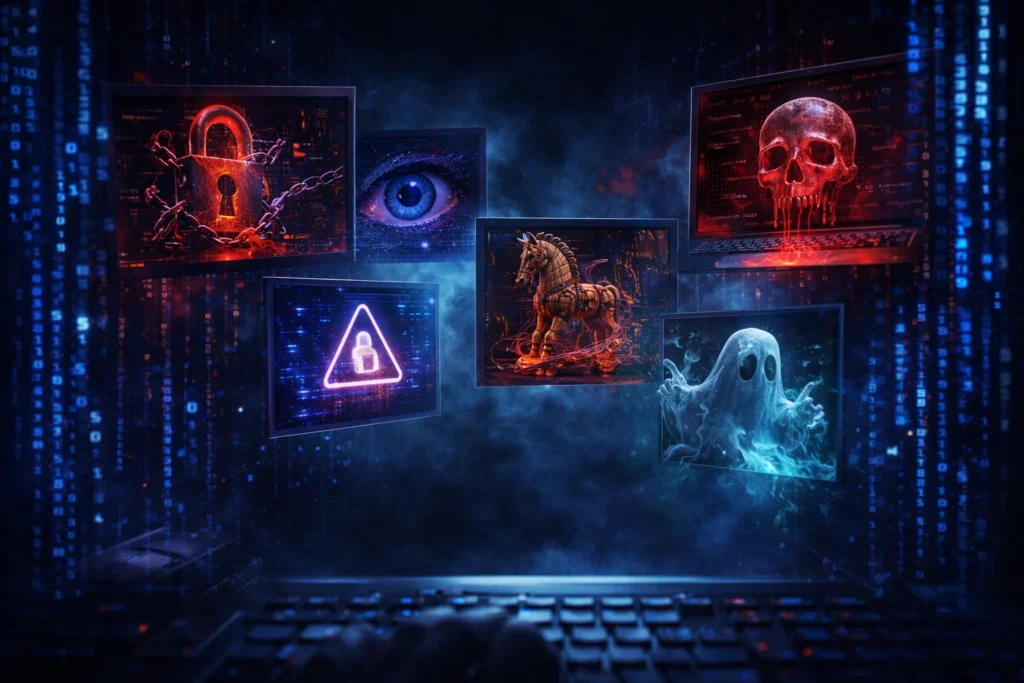
A. The Extortionists and Disruptors — They Want to Wreck Your Day
1. Ransomware
This one’s the big bad wolf of the malware world. Ransomware sneaks onto your system, locks up all your files, and then basically says “pay up or you’ll never see your data again.” And it’s gotten way more aggressive lately. These days, attackers don’t just encrypt your stuff — they also threaten to post it online if you don’t pay. That’s called “double extortion.” Some gangs even go after your customers too, which is “triple extortion.” Charming, right?
2. Wiper Malware
At least ransomware wants money. Wiper malware? It just wants to watch the world burn. There’s no ransom demand, no negotiation — it just deletes everything it can touch, permanently. This stuff is mostly used in nation-state cyberwarfare to take down governments and critical infrastructure. The NotPetya attack back in 2017 caused over $10 billion in damage using exactly this kind of code. Scary stuff.
3. Logic Bombs
Imagine a ticking time bomb hidden inside a perfectly normal-looking piece of software. That’s basically what a logic bomb is. It sits there completely dormant — sometimes for months or even years — and then goes off the moment a specific trigger happens, like a certain date arriving or a particular user logging in. What makes them especially sneaky is that they’re often planted by insiders, like a disgruntled employee setting one to explode after they’ve been fired.
B. The Silent Spies and Data Thieves — They’re Watching You Right Now
4. Spyware
Spyware is exactly what it sounds like — software that spies on you without you having the faintest clue. It sits quietly in the background, watching everything you do, collecting your passwords, tracking your browsing, and hoovering up your financial details. Some commercial versions like Pegasus are so advanced they can literally activate your phone’s microphone and camera without you knowing. Creepy doesn’t even begin to cover it.
5. Keyloggers
Think of keyloggers as spyware’s laser-focused little sibling. Instead of watching everything, they just record every single key you press on your keyboard. Every password, every bank detail, every private message — all silently logged and shipped off to whoever planted it. They’re often bundled inside other malware as a nice little bonus for attackers.
6. Infostealers
These are one of the fastest-growing threats in 2026 and honestly deserve way more attention than they get. Infostealers are built for one thing — grab as much of your stored data as possible, as fast as possible, and get out. We’re talking saved passwords from your browser, session cookies that let attackers log into your accounts without even needing your password, crypto wallet details, the lot. Tools like Lumma Stealer are freely available on dark web markets, which means pretty much anyone can deploy one now.
7. Banking Trojans
These sneak onto your device disguised as a totally normal app — maybe a fake banking app, a utility tool, or something that looks genuinely useful. Once they’re in, they inject themselves into your browser sessions, intercept your one-time passwords, and can even redirect your transactions without you noticing. Emotet started life as a banking trojan and ended up becoming one of the most destructive malware platforms ever built.
C. The Infiltrators and Persistent Threats — Once They’re In, They’re Hard to Shift
8. Trojans
Named after the classic Greek trick with the wooden horse — and for good reason. A trojan looks completely harmless, maybe even useful, until you install it and suddenly attackers have the keys to your front door. They don’t spread on their own like worms do; their whole game is deception. Get you to install them, then quietly open a backdoor for whoever sent them.
9. Worms
Worms are the ones that spread on their own without needing you to do anything at all. No clicking, no opening files — they just find a vulnerability in your network and hop from machine to machine automatically. WannaCry is the classic example — it infected 200,000 computers across 150 countries in a single day. One worm, no user interaction required. Terrifying.
10. Viruses
The classic. Everyone’s heard of computer viruses, and they’re still very much around. A virus attaches itself to a legitimate file or programme and spreads every time that file gets opened or shared. Unlike worms, they do need a human to accidentally help them along — opening an infected email attachment, running a dodgy installer, plugging in an infected USB. Old school, but still effective.
11. Rootkits
Rootkits are probably the sneakiest thing on this entire list. They bury themselves so deep inside your system — sometimes below the operating system itself — that your security software literally cannot see them. They give attackers full administrative control while hiding completely from view. Getting rid of them often means wiping the entire system. Some can even survive a factory reset because they embed themselves in the firmware.
12. Backdoors
A backdoor is basically a secret entrance into your system that bypasses all the normal security checks. Sometimes they’re planted by other malware as a way to stay connected even after the initial infection has been cleaned up. Think of it like a burglar who, after breaking in once, quietly makes a copy of your house key so they can come back whenever they fancy.
D. The Resource Hijackers — They’re Using Your Stuff Without Asking
13. Botnets
A botnet turns your computer into what’s basically a zombie — your device looks fine to you but it’s secretly being controlled by an attacker and used as part of a massive network of infected machines. These zombie networks get used for all sorts of nasty things: flooding websites with traffic until they crash (DDoS attacks), sending millions of spam emails, or mass-testing stolen credentials. The Mirai botnet hijacked hundreds of thousands of smart home devices to pull off some of the biggest DDoS attacks ever recorded.
14. Cryptojackers
This one’s a bit cheeky. Cryptojacking malware hijacks your CPU and GPU to mine cryptocurrency — for the attacker, not you. You won’t necessarily know it’s happening, but you’ll notice your device running hot, your fan going into overdrive, and your electricity bill quietly climbing. The attacker sits back and collects the mining rewards while you foot the bill.
15. Adware
Adware often gets dismissed as just annoying rather than dangerous — and yeah, being bombarded with pop-up ads is more irritating than terrifying. But here’s the thing: adware frequently acts as a gateway drug to worse infections. It tracks your browsing behaviour, redirects you to sketchy sites, and often comes bundled with nastier stuff hiding in the background. Don’t ignore it just because it seems harmless.
E. Next-Gen and Evasive Threats — The Smart Ones
16. Fileless Malware
This is where things get properly clever in a very bad way. Fileless malware never actually writes anything to your hard drive. It lives entirely in your system’s memory and uses legitimate built-in Windows tools — like PowerShell — to do its dirty work. Because there’s no file to scan, traditional antivirus tools often miss it completely. It’s like a burglar who breaks in, does what they came to do, and leaves absolutely zero fingerprints.
17. Hybrid Malware
Why be one type of threat when you can be several at once? Hybrid malware mixes and matches capabilities — a worm that also acts like a rootkit, or a trojan that drops ransomware while running a keylogger in the background. These combinations are specifically designed to hit harder and dodge detection more effectively. They represent the cutting edge of what attackers are building right now in 2026.
What’s Trending in 2026: AI is Changing Everything
Things are getting more complicated because attackers are now using AI to make their malware smarter. Around 37% of new malware samples show signs of AI optimisation — meaning the malware can automatically tweak itself to dodge detection, adapt to its environment, and speed up reconnaissance. It’s basically malware that learns on the job. Great for attackers, nightmare for defenders.
SEO poisoning is another one that’s blowing up right now. Criminals are literally hacking Google’s search rankings to push fake download pages to the top of results for popular software tools. You search for a free PDF editor, click the top result, and end up installing an infostealer instead of the app you wanted. Always double-check where you’re downloading software from.
And if you thought multi-factor authentication made you safe? Meet Phishing-as-a-Service kits like Tycoon 2FA. These ready-made kits let even low-skill criminals intercept your MFA codes in real time. It’s getting easier for attackers and harder for defenders every single month.
Real Stories That Show Why This Matters
WannaCry (2017) WannaCry tore through 200,000 computers in 150 countries in a single day using a Windows vulnerability called EternalBlue. The wild part? Microsoft had already released a patch for it two months earlier. The organisations that got hit simply hadn’t bothered to update. The UK’s NHS alone lost an estimated £92 million and had to cancel thousands of appointments. Update your systems. Seriously.
Colonial Pipeline (2021) One old VPN account with no MFA enabled. That’s all it took for the DarkSide ransomware group to shut down the biggest fuel pipeline in the United States and trigger fuel shortages up and down the East Coast. Colonial paid $4.4 million in ransom within hours. The lesson here is painfully simple — a password alone is never, ever enough.
PowerSchool (2025) A single breach of an education software provider exposed the data of 62 million students and teachers across North America. One vendor, one attack, millions of victims. It’s a brutal reminder that your security is only as strong as the weakest link in your supply chain.
How to Actually Protect Yourself in 2026
You don’t need to be a security expert to stay protected. You just need to be consistent with a few key habits.
Back everything up — the 3-2-1 way. Keep three copies of your important data, on two different types of storage, with one copy stored offsite or in an isolated cloud. If ransomware hits, clean backups mean you can recover without paying a penny.
Ditch traditional antivirus for EDR. Old-school antivirus tools that just scan for known threats aren’t cutting it anymore, especially against fileless malware. Endpoint Detection and Response (EDR) tools watch for suspicious behaviour rather than just known signatures — much harder to fool.
MFA on everything, no exceptions. Colonial Pipeline proved that passwords alone don’t cut it. Turn on multi-factor authentication on every account, every system, every remote access point. Yes, all of them.
Patch your software the moment updates drop. WannaCry devastated organisations using a vulnerability that had already been fixed. There is genuinely no good reason to delay a security patch. Automate it if you can.
Quick Questions You’ve Probably Googled
Can Macs get malware? Yep, absolutely. The whole “Macs don’t get viruses” thing is a myth that needs to die. macOS malware made up 13% of all detections in 2025 — infostealers and adware are particularly common on Apple devices now.
Does a factory reset remove malware? Most of the time, yes. But if you’re dealing with a rootkit that’s embedded itself in your device’s firmware, a factory reset won’t touch it. Those cases usually need professional help or a hardware replacement.
Is paying a ransom illegal? Generally no — it’s not illegal in most places. But it could get complicated if the attackers turn out to be a sanctioned group under international law, like a state-sponsored gang. Always talk to a lawyer before handing over any money.
Bottom Line: Know Your Enemy
Here’s the thing about malware — it’s not just an IT problem anymore. It’s a business problem, a personal problem, and increasingly a national security problem. The $12.5 trillion price tag isn’t built from a handful of big attacks. It’s thousands of smaller incidents that started with something totally preventable — a missed update, a weak password, a dodgy download link.
You don’t have to become a cybersecurity expert overnight. But knowing the difference between a keylogger and a rootkit, understanding why fileless malware is such a headache, and recognising an SEO poisoning attempt when you see one? That knowledge is genuinely worth more than most security tools you could buy.
Stay curious, stay updated, and for the love of everything — turn on MFA.